
When I was finishing my PhD, I imagined that working as an R&D scientist in biotech would feel similar to running a research project in academia—just with more resources and bigger teams.
I assumed I would help develop a product or a drug from beginning to end.
Many academic trainees have the same expectation.
My first industry job taught me something very different:
I wasn't hired to own the product—I was hired to own my expertise.
Since finishing my PhD, I've worked as an R&D scientist in three very different environments: biomarker discovery, scientific instrumentation development, and therapeutic antibody process development. Although the science, business priorities, and company cultures were very different, one pattern stayed remarkably consistent:
You don't own the product—you own the expertise you bring to the team.
I'll use my first role as a biomarker discovery scientist to illustrate what I mean.
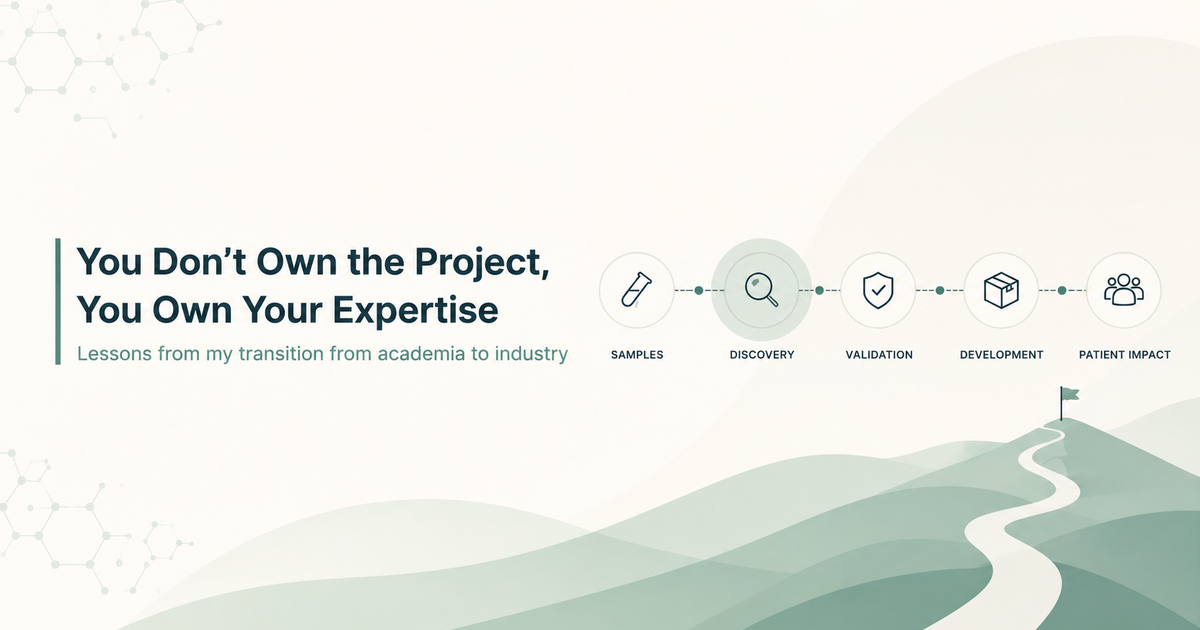
Our team sat at the very beginning of the product development pipeline, identifying novel protein biomarkers that could eventually become diagnostic tests.
Coming from academia, I expected to stay involved throughout the entire process.
Instead, I quickly realized every stage was owned by a different team.
Clinical teams obtained patient samples.
My team discovered potential biomarkers.
Validation scientists confirmed promising candidates.
Product development teams turned them into diagnostic assays.
Other groups studied the underlying disease biology.
During my PhD, I had done versions of many of these tasks myself. In industry, I was responsible for only one piece of the puzzle.
At first, that felt limiting.
I knew how to perform many of the downstream experiments, so I wondered why my role was intentionally so focused.
Over time, I realized this wasn't a limitation—it was the reason the company could move so efficiently.
Rather than asking every scientist to master every technique, industry builds cross-functional teams where each group develops deep expertise in a specific area. Everyone moves the project forward by solving a different set of problems.
As a biomarker discovery scientist, my responsibility wasn't to validate biomarkers or develop diagnostic kits. My job was to make our discovery workflow more sensitive, robust, and reliable so that the best candidates could move into the next stage of development.
That was the expertise I was hired to provide.
Looking back, this was one of the biggest mindset shifts I had to make after leaving academia.
A PhD trains us to become independent researchers who can solve many different scientific problems. Industry still values that ability—but your impact comes from applying it within a clearly defined area of expertise.
You don't need to solve every problem.
You need to become the person your teammates rely on for your problem.
Key Takeaways
Don't expect to own an entire product or drug development program. Industry R&D is built around cross-functional collaboration.
Specialization is a strength, not a weakness. Companies move faster when every team becomes exceptionally good at one part of the process.
Your value comes from solving your team's problems exceptionally well, not from doing everything yourself.
Understanding where your work fits in the bigger picture will help you become a stronger industry scientist.
In my next post, I'll share how this lesson became even more apparent when I transitioned into a CDMO, where the meaning of "owning your expertise" looked very different from my first biotech role.