
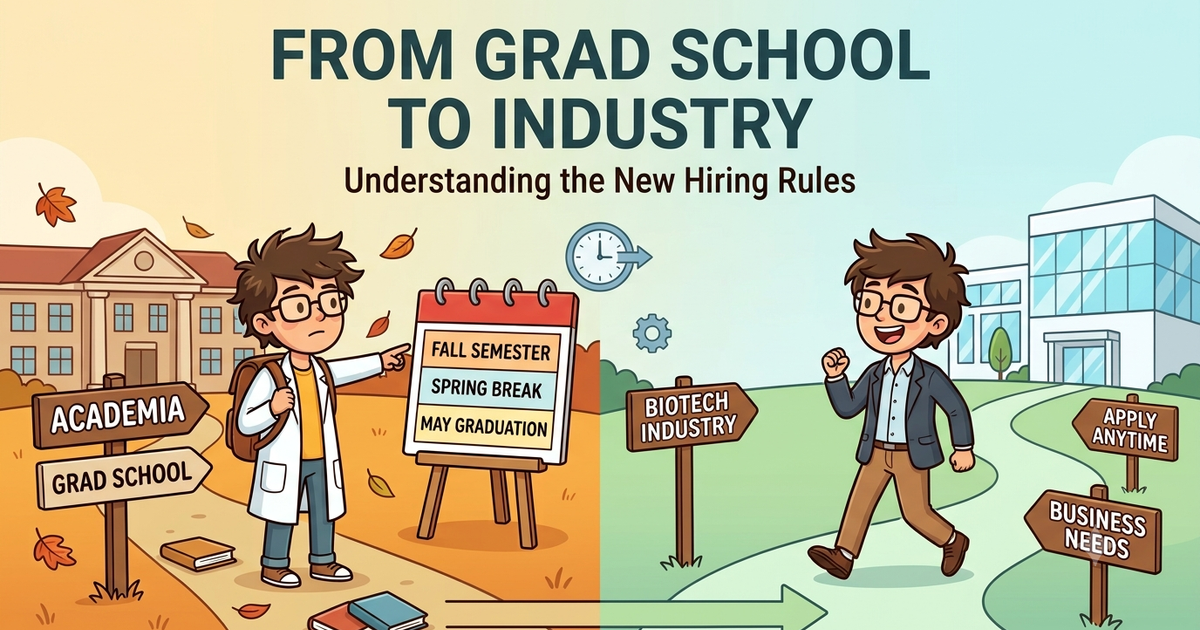
If you're a graduate student planning to move from academia into industry, you may assume there is a specific recruiting season when you should start applying.
There often isn't.
One of the biggest differences I noticed when I moved into biotech is that industry hiring is driven by business needs rather than the academic calendar. Before deciding when to apply, it helps to understand how that hiring process actually works.
Why Industry Hiring Doesn't Follow the Academic Calendar?
From the hiring side, positions typically become available because a company has a specific business need. For example, a team may be expanding, launching a new research program, adding a new technical capability, or backfilling a position after someone leaves.
I was fortunate enough to apply for positions that opened for different reasons, and after working in biotech for five years, I’ve started to understand why this matters for graduate students.
A company doesn't necessarily think:
“A lot of PhD students will graduate in May. Let's open some Scientist positions in February.”
Instead, the thinking is more likely to be:
“We need another scientist for this project. When can we get someone into the position?”
That difference is easy to overlook when you're coming from academia.
For example, if a company needs a Scientist to support a new program starting in June and you graduate in May, your timing could be excellent. But if a position opens in January because someone unexpectedly leaves, the hiring manager may need someone who can start much sooner.
That's why there isn't one universal “right month” to apply for industry jobs. The best timing depends on when you'll be available and when the company needs someone to start.
How long does the industry hiring process take?
Another reason timing matters is that the application date is not the same as the start date.
For an R&D position, the process may involve:
Recruiter or HR screening
Hiring manager interview
Technical or team interviews
Panel interviews
A scientific presentation or seminar
Reference checks or other pre-employment steps
Offer negotiation
The exact process varies significantly by company and position. Larger organizations may take longer because more people are involved, while smaller companies may move faster—but there is no universal timeline.
You're usually not the only candidate
A hiring team may interview several qualified candidates before making a decision. The process can also slow down because of interviewer availability, internal approvals, or changing business priorities.
So don't assume that applying today means you'll know your outcome in two weeks.
The offer is not necessarily the start date
Even after you receive an offer, there can still be a gap before your first day.
As a graduate student, you may still need to finish your thesis, complete degree requirements, relocate, or arrange work authorization.
Companies may be able to accommodate a later start date, but the amount of flexibility depends on the role and the hiring team's needs.
If the team needs someone immediately, they may prioritize a candidate who can start sooner.
If the position is tied to a project that won't begin for several months, the team may have more flexibility.
This is why availability is part of your candidacy.
It doesn't mean you should graduate early just to get a job.
It means you should understand how your expected availability fits the position you're applying for.
What does this mean for PhD students?
There are really three different activities:
Preparing: understanding target roles, improving your resume, and preparing for interviews.
Networking: talking with industry scientists, alumni, recruiters, and other professionals.
Applying: submitting applications for specific positions.
These don't have to start at the same time. Preparation and networking should generally begin well before you start submitting applications.
The bottom line
Industry hiring is not synchronized with your thesis defense.
Companies hire when they have a need.
Your job is to understand that need and determine whether your availability, experience, and skills line up with it.
So don't ask only:
“When should a PhD student apply for industry jobs?”
Ask:
“When should I start preparing, when should I start applying, and how does my availability match the company's hiring need?”
That's the question we'll tackle in the next article, where I'll walk through a practical timeline for a student graduating in May 2027.